HISTORY
Ancient Nepal
At the outset, it has to be mentioned that the history of ancient Nepal is
the history of Kathmandu Valley. There are two reasons for this. One is the lack of
historical records for other parts of Nepal and the other is that the colorful past of
this beautiful valley easily out dazzles what is known about elsewhere. There is also the
fact that the name of the country is taken from what Kathmandu used to be known in earlier
times – Nepal valley.
The tale of Kathmandu dates
back to the time when the Gods communed with mortals. A glimpse into that period can be
found in the Buddhist chronicles that tell of the coming of the Manjushree Bodhisattva
from China to worship Swayambu. As the legend goes, Swayambu, a manifestation of Adhi
Buddha, the primordial Buddha was a brilliant flame emanating from a lotus flower that
rested in the midst of the lake Nagarad. From atop distant Mandapgiri (now Nagarkot),
Manjushree gazed at this wondrous sight and decided to worship this flame more closely. By
going to the lowest hill in the southern part of the valley and slicing a portion of it
with his Sword Of Wisdom, he drained the lake, thus creating the Chobar Gorge (which till
today drains the rivers of the Kathmandu Valley). The valley with its fertile soil
appeared, and Manjushree proceeded on his mission to worship the Swayambhu, which had
rested upon the small hillock of present-day Swayambhu.
Manjushree is then said to
have founded the city of Manjupatan, which was located midway between Swayambhu and
Gujeshwori (near what is today the Kathmandu airport), and proclaimed his disciple
Dharmakarma as the ruler of that city. It was also during this era that Krakuchanda
Buddha, Kanak Muni Buddha and Kashyapa Buddha visited the Kathmandu valley to worship
Swayambhu and Gujeshwori.
Aware that Kaliyug, the Dark
Age, was drawing near, Kanak Muni Buddha sent Prachanda Deva, King of Gaur (Bengal), to
cover the flaming image of Swayambhu since only such an act would preserve it from the
gaze of the sin-ridden world. So, Prachanda Deva built a stupa encasing the sacred flame
of Swayambhu.
Later, Prachandra Deva sent
his son Shakti Deva to enthrone their cousin
Gunakama Deva as King of Nepal. Gunakama’s reign saw a great famine afflict the
kingdom but with aid from the Goddess Shantishree, he was able to overcome that disaster.
The last king of this dynasty was Singhakhetu and, in his reign, the country flourished in
both trade and commerce. It is said that the kingdom even conducted trade with places as
far away as Singhaladeep (Sri Lanka).
The demise of Gunakama’s
dynasty saw a succession of rulers from the provinces of India such as Bengal and even
from as far as Madras rule Kathmandu. The most renowned was Dharmadutta of Kanchipuram who
is said to have built the Pashupatinath Temple. Boudhanath may have been built by
Dharmadutta’s second successor. Then came the Ahir or Abhir Dynasty who were a race
of cowherds. There were eight kings in this line, the first being Bhuktaman and the last
Yaksha Gupta. Owing to pastoral disputes, this dynasty was then replaced by another Abhir
dynasty of shepherds. This second Abhir dynasty had a succession of three kings and their
rule ended when the Kirati invaders defeated Bhuban Simha.
The Kiratis
The Kiratis were a tribal
hill people who came from the East. (The Ramayana mentions them as being dwellers of the
northeastern Himalayan region.) The Kirati invasion of the Kathmandu valley occurred
sometime around 700 BC. The mist famous among the Kirati rulers was Yalambar – the
first of them.
Jitadassi, the seventh king,
is said to have helped the Pandavas during the Great War of the Hindu epic the
Mahabharata. It was also during the reign of Jitadassi that Gautama Buddha was said to
have visited the Valley. The Kiratis’ rule saw a succession of 29 kings until the
Licchavis at around AD 200 defeated Gasti, the last of them.
The Licchavis
The advent of the Licchavis
brought in the first golden era of Nepalese art and Culture. They were also the ones who
introduced the Hindu caste system into the valley. Among the 48 Licchavi rulers, Mana Deva
I, who ascended the throne in AD 464, was a ruler of considerable talent and abilities. He
consolidated the kingdom in all directions with his powerful army and political tact.
Besides this, he was also a patron of the arts. Pagoda-roofed structures came into vogue.
Sculptors fashioned exquisite images of their Gods and Kings. It was during this same
period that the temples of Changunarayan, Vishabjynarayan, Sikhomanarayan and Ichabgunarayan
were built.Other notable masterpieces include the Reclining Vishnu of Budhanilkantha, the
gilting of the roof of Pashupatinath Temple, the struts of Hanuman Dhoka and the
Basantapur Tower, the Uku Bahal in Patan, and the Indreshwar Mhadev Temple at Panauti.
The Thakuris
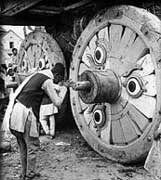 Amsuvarma, of the Thakuri
lineage, ascended the throne in AD 605 upon the death of his father-in-law Shivadeva, a
Licchavi King. According to the travelling Chinese monk Huen Tsanf, Amsuvarma had attained
high military and literary glory. Of his palace at Deopatan, Huen Tsang says that it was
seven stories high and ornamented with gems and pearls. Amsuvarma made matrimonial
alliances with both his powerful neighbors of the north and the south. To Tsrongsten
Gompo, Tibet’s powerful ruler, he offered his daughter, Bhrikuti, and to the Indian
Prince, he offered the hand of his sister. (It was Bhrikuti, along with a Chinese
princess, who converted the Tibetan king to Buddhism, thus heralding the advent of the
religion the country was to later become famous for. Bhrikuti is considered the Green Tara
of the Buddhist psntheon while the Chinese princess is known as the White Tara.)
Amsuvarma, of the Thakuri
lineage, ascended the throne in AD 605 upon the death of his father-in-law Shivadeva, a
Licchavi King. According to the travelling Chinese monk Huen Tsanf, Amsuvarma had attained
high military and literary glory. Of his palace at Deopatan, Huen Tsang says that it was
seven stories high and ornamented with gems and pearls. Amsuvarma made matrimonial
alliances with both his powerful neighbors of the north and the south. To Tsrongsten
Gompo, Tibet’s powerful ruler, he offered his daughter, Bhrikuti, and to the Indian
Prince, he offered the hand of his sister. (It was Bhrikuti, along with a Chinese
princess, who converted the Tibetan king to Buddhism, thus heralding the advent of the
religion the country was to later become famous for. Bhrikuti is considered the Green Tara
of the Buddhist psntheon while the Chinese princess is known as the White Tara.)
After the death of Amsuvarma
in AD 629, power reverted to the Licchavis once again for a considerable period of time.
It was only in AD 879 that Raghadeva founded the real Thakuri Dynaty. To commemorate this
event, Raghadeva established the Nepal Sambat Era, a calendar that is still followed by
the Newars of Kathmandu Valley and is running in its 12th century.
The reign of the later Thakuris has
been considered the Dark Age in the history of Kathmandu on account of much strife and
turmoil during this period and that included the ravages of multiple foreign invasions.
But trade and commerce still flourished and cities and settlements grew.
Another King, Ganakamadeva,
who ruled from AD 949 till AD 994 deserves special mention. It was he who introduced the
important festivals of Indra, and Kridhna Jayanti. But more importantly, Gunakamadeva
founded Kantipur, today’s Kathmandu.
The Mallas
In AD1200, King Arideva
assumed the title of Malla, and the dynasty of the Mallas ruled Kathmandu Valley for a
total of 568 years. At one time, during the reign of King Yakshya Malla (1428-1482), the
Valley’s territorial gains had extended north as far as Digarcha in Tibet, Gorkha to
the west, Morang to the east, and southwards up to Bodh Gaya in Bihar, India.

The early period of the Malla
rule saw peace and tranquility with a great deal of progress in all spheres of life.
Though the Mallas were Vaishnavite and Shaivite Hindus, they showed tolerance towards
other religions too. Endowment monasteries, Muslims were allowed to settle in the Valley
although they were forbidden to convert others. Even a Roman Catholic Mission of the
Capuchin order was allowed into Kathmandu and granted land by royal decree.
The Mallas were benevolent
patrons of the arts and it was during their reign that a renaissance of the arts
flourished. Traditionally passed down from father to son, the skills of proficiency.
Further developments evolved with new ideas being acquired from neighboring kingdoms.
These craftsmen excelled in stone carving, woodcarving, brick making, metal work and
painting.
The fame of Arniko
In the 13th
Century, Arniko, a Newar architect and master craftsman of Bhaktapur, was invited to build
a stupa in Tibet at the request of Kublai Khan. Word had reached the ears of the Mongol
emperor about Arniko’s prowess as a master builder. Soon, after the initial
assignment, Arniko was conscripted into the Court of China as "The Controller of
Imperial Manufacture."
Other Newari craftsmen were
also invited to Tibet and China. On their return, they brought back a new style, which was
a fusion of their original newari style combined with Tibetan (Chinese) art. An example of
this style is seen in the Golden Gate of Bhaktapur, which was built in 1754. It has
Tibetan and Chinese motifs inlaid among the periodic designs.
Communes of Clay
Bricks were the main
components used in construction. The Newari builders had devised a method of strengthening
regular-fired bricks by mixing oil to the clay. Called Chikau Uppa (or Telia Eet in
Nepali) meaning "oiled brick," this 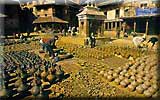 novel technique brought about stronger and
longer-lasting constructions. Houses, temples, street and courtyards were all constructed
with this brick.
novel technique brought about stronger and
longer-lasting constructions. Houses, temples, street and courtyards were all constructed
with this brick.
Besides the three principle
cities, other settlements grew around the Kathmandu Valley. Fortresses were set up at
strategic points to serve as defense outposts which also provided protection to the
farming community spread all across the Valley. Others grew up along the flourishing trade
routes. Wary of attack by bandits and foreign invaders, people built their houses in close
clusters, often on higher ground and high walls further fortified these.
Lalitpur
The renaissance during the
Malla eras saw further development in the craft of image making. Stone carvings of the
earlier times gave way to mental craft. All the spires of important temples and shrines
were crowned with gold; this technique of gilding involved a chemical compounding process.
Skill in metal craft reached a high degree of excellence and Patan, or Lalitpur (city of
arts) became the center. The best example of that period can still be seen today in the 14th
century Kwa Bahal, the Golden Temple. Tibetan pilgrims who came on pilgrimage to this site
were so enraptured by the sight of it that they called it "Yerang" meaning
"Eternity Itself."
Bhaktapur
 While the artisans of Patan
excelled in metalwork, the artisans of Bhaktapur pursued the traditional craft of stone
and woodcarving. Evidence of their excellence is still visible today as one observes the
55-Windowed Palace, the Peacock Windows, and the Nyatopola Temple – all built during
the reign of King Bhupatindra Malla.
While the artisans of Patan
excelled in metalwork, the artisans of Bhaktapur pursued the traditional craft of stone
and woodcarving. Evidence of their excellence is still visible today as one observes the
55-Windowed Palace, the Peacock Windows, and the Nyatopola Temple – all built during
the reign of King Bhupatindra Malla.
It is believed that
Bhupatindra Malla was brought up by a carpenter since his step-mother had ordered to have
him killed to make way for her own offspring to become king. He is considered to be among
the ablest rulers of Bhaktapur. He was also a contemporary of Shah Jahan, the Indian
emperor who built the Taj Mahal. In all likelihood, it is possible that the Moghyl Emperor
and his sense of grandiose art inspired Bhupatindra Malla.
Paubha –Newari Paintings
From the 11th
century, religious manuscripts were being embellished with paintings. Buddhism inspired
the earliest of these. Drawn on palm leaf strips, these simple ink sketches were accented
with basic natural colors. After the 15th century, paper began to replace the
leaf.
The Newars also had a
miniature form of painting till the 14th  century that was distantly related to
the Indian Pahari School. Thereafter, that from gave way to scrolls painting. Like the
craftsmen, Newar painters had also been invited to Tibet to paint murals and scrolls in
the monasteries. Tibet was then a prosperous trading country. Traders travelling the Silk
Route brought in merchandise from other kingdoms and this provided an opportunity for the
artists from Kathmandu to study the arts of the other parts of Asia. As a result, they
were able to incorporate their own and other styles into the traditional Tibetan art and
evolves a whole new genre. When the Newar artists returned back to their Kingdoms once
more, they used their knowledge to create splendid works of art in Kathmandu valley.
century that was distantly related to
the Indian Pahari School. Thereafter, that from gave way to scrolls painting. Like the
craftsmen, Newar painters had also been invited to Tibet to paint murals and scrolls in
the monasteries. Tibet was then a prosperous trading country. Traders travelling the Silk
Route brought in merchandise from other kingdoms and this provided an opportunity for the
artists from Kathmandu to study the arts of the other parts of Asia. As a result, they
were able to incorporate their own and other styles into the traditional Tibetan art and
evolves a whole new genre. When the Newar artists returned back to their Kingdoms once
more, they used their knowledge to create splendid works of art in Kathmandu valley.
Political Strife
King Yakshya Malla, who ruled
from AD 1428 to 1482, was reckoned to be the bravest and most distinguished among all the
Malla kings. It was during his reign that the kingdom grew to its largest extent, as has
been mentioned earlier, and, like his predecessors, he was a great patron of the arts.
Besides that, he was also a benevolent ruler who gave alms to the poor and improved the
living conditions of his subjects by building canals and waterways for farmers. But prior
to his death he committed a grave mistake that was to bring to an end the glorious age of
the Malla Empire.
 Yakshya Malla divided his
kingdom among his sons, and so for a hundred and fifty yearsonwards, the independent
kingdoms of Kantipur, Bhaktapur, Lalitpur and Banepa by modern Nepal. The conquest of
Kathmandu Valley, which took a total of ten years of planning, siege and diplomacy, was
the highlight of his conquests. His descendants continued the work begun by King Prithvi
Narayan. At the greatest extent the Nepali (then known as the Gorkhali) Empire covered an
area that was at least a third more than its present confines.
Yakshya Malla divided his
kingdom among his sons, and so for a hundred and fifty yearsonwards, the independent
kingdoms of Kantipur, Bhaktapur, Lalitpur and Banepa by modern Nepal. The conquest of
Kathmandu Valley, which took a total of ten years of planning, siege and diplomacy, was
the highlight of his conquests. His descendants continued the work begun by King Prithvi
Narayan. At the greatest extent the Nepali (then known as the Gorkhali) Empire covered an
area that was at least a third more than its present confines.
Around this time, Nepali
expansionism came into conflict with the British, who were themselves busy with their own empire-building spree. The two
forces met in a series of battles that culminated in the Treaty of Sugauli in 1816. The
Treaty reduced the recently expanded Nepali kingdom by a great deal but after that Nepal
was left alone.
The lull that followed the
ceasing of external hostilities, however, saw a series of internal conflicts begin. These
power struggles were the result of the polarizing of authority between the then king
Rajendra Bikram Shah’s multiple queens who supported different aristocratic clans in
their proxy fights.
In 1846, Jung Bahadur Rana
usurped power as Prime Minister with the help of one of the queens and arrogated the right
of his family to rule by decree as Prime ministers and relegated the monarchy to the
backstage. This oligarchy of the Ranas, not unlike the shogunates of Japan, lasted for 104
years in which the post of Prime Minister was transferred from brother to brother.
 During this time, the country
was bled white by the Rana rulers in their quest for emulating the grandeur of the
British. Innovation of any kind within the country was disallowed and the people were kept
on a tight leash. Criticism of their rule was brooked from no one, even from within their
own family. But the most notable feature of the Rana rule was that Nepal was kept in
isolation throughout the long century of their power.
During this time, the country
was bled white by the Rana rulers in their quest for emulating the grandeur of the
British. Innovation of any kind within the country was disallowed and the people were kept
on a tight leash. Criticism of their rule was brooked from no one, even from within their
own family. But the most notable feature of the Rana rule was that Nepal was kept in
isolation throughout the long century of their power.
That ended in 1949 when the
then King Tribhuwan (the present King’s grandfather) took on the might of the Ranas
and with the help of a popular armed revolt forced the Ranas to surrender power. Political
parties then openly entered the Nepali political scene. The first post-1949 government was
a coalition between the Ranas and the Nepali Congress, the party that had led the revolt.
The coalition floundered in
no time due to a split in the Nepali Congress. After this followed period of period of
political instability with governments being successively formed and failing. It needs to
be noted here that none of the governments constituted then had a popular mandate; their
formation being purely a matter of the king’s pleasure.
In order to end this
uncertainty in the political scene, general elections were called in 1958. The Nepali
Congress came to power with an overwhelming majority. But in 1960, King Mahendra, the
present king’s father, engineered what has been called a ‘palace coup’.
Moving swiftly, he had all political parties banned, the leaders, ruling as well as
opposition, thrown into prison, power consolidated into his own hands and a political
system called the partyless Panchayat system adopted.
 It was through this political
dispensation that King Mahendra and later the present King Birendra Bir Bikram Shah ruled
Nepal for 30 years. All along political dissent was not tolerated. Things changed slightly
after the 1980 national referendum, which was called after a student-led unrest began to
get increasingly violent. The referendum asked the people to choose between the existing
partyless Panchayat system and a multi-party system and the partyless Panchayat system won
55 percent of the votes amidst charges of massive rigging.
It was through this political
dispensation that King Mahendra and later the present King Birendra Bir Bikram Shah ruled
Nepal for 30 years. All along political dissent was not tolerated. Things changed slightly
after the 1980 national referendum, which was called after a student-led unrest began to
get increasingly violent. The referendum asked the people to choose between the existing
partyless Panchayat system and a multi-party system and the partyless Panchayat system won
55 percent of the votes amidst charges of massive rigging.
But despite all efforts the
Panchayat system was doomed to failure. In 1990, the Nepali Congress and the communists
joined hands for the first time to try and overthrow the Panchayat system. During a
campaign, at times bloody, that lasted a month and a half, it became evident that the
Panchayat system could not last long. King Birendra, recognizing this fact bowed to
popular will and lifted the ban on political parties.
An interim government
representing the Nepali Congress, the communists and the palace, with the explicit mandate
to get a new constitution for Nepal ready and to hold general elections, was formed under
Krishna Prasad Bhattarai, the Nepali Congress president.
The elections held in 1991
saw the Nepali Congress come to power with a slight majority. The communists were the main
opposition. The Rastiya Prajarantra Party (National Democratic Party), the party of
players in the Panchayat system and the India-looking Nepal Sadbhavana Party (Nepal
Goodwill Party) received three and six seats respectively in the 205-member House of
Representatives, the lower house of parliament. The National Council, the upper house, saw
a proportionate breakup in the number of seats each party received.
The government formed by the
Nepali Congress under the premiership of Girija Prasad Koirala lasted roughly three years
when intra-party wrangling within the Nepali Congress led to the government’s fall in
1994. In the general election held subsequently, none of the parties was able to secure a
majority. A government was formed by the Nepal Communist Party (United Marxist-Leninist),
the party with the highest number of seats in the House of Representatives, with all the
other parties giving it support from outside the government.
However, eight months later
in mid 1995, the Nepali Congress, which has the second highest number of seats in the
parliament, and the other parties withdrew support from the government. The then Prime
Minister Manmohan Adhikari dissolved the House of Representatives and called for fresh
elections. But his action was challenged in the Supreme Court. After months of
uncertainty, the Court decided to reinstate the parliament. In view of the changed
circumstances the government of Adhikari resigned and a coalition government of the Nepali
Congress and two smaller parties was formed in August with Sher Bahadur Deuba of the
Nepali Congress as Prime Minister.
In parliament, the Rastriya
Prajatantra Party (RPP), the third largest party had the numbers that could tilt the
balance of power. And the RPP was divided into two groups, one which favored staying on in
government under the Nepali Congress and the other that preferredto take charge of the
government with help from the communists. Ultimately, the faction that was closer to the
communists triumphed and was successful in pulling down the Deuba government. Following
this, Lokendra Bahadur Chand of the RPP became Prime Minister in a three-party coalition
government.


